Philippines Police Clearance Sample 2026: Official Format, Validity & Fake vs. Genuine Guide
Understanding a police clearance sample is essential for anyone applying for employment, immigration, visa processing, business registration, or government-related requirements. A police clearance sample provides a clear view of the document’s structure, including personal information, clearance status, reference numbers, issuance details, and official authentication. Unlike in the past, when police clearance certificates varied from one municipality to another. Whether you apply for a police clearance in Manila, Davao, Cebu, or any other location in the Philippines, the document follows the same official design, layout, and verification system.
In this guide, you’ll find a detailed police clearance sample along with explanations of each section to help you better understand this important legal document.
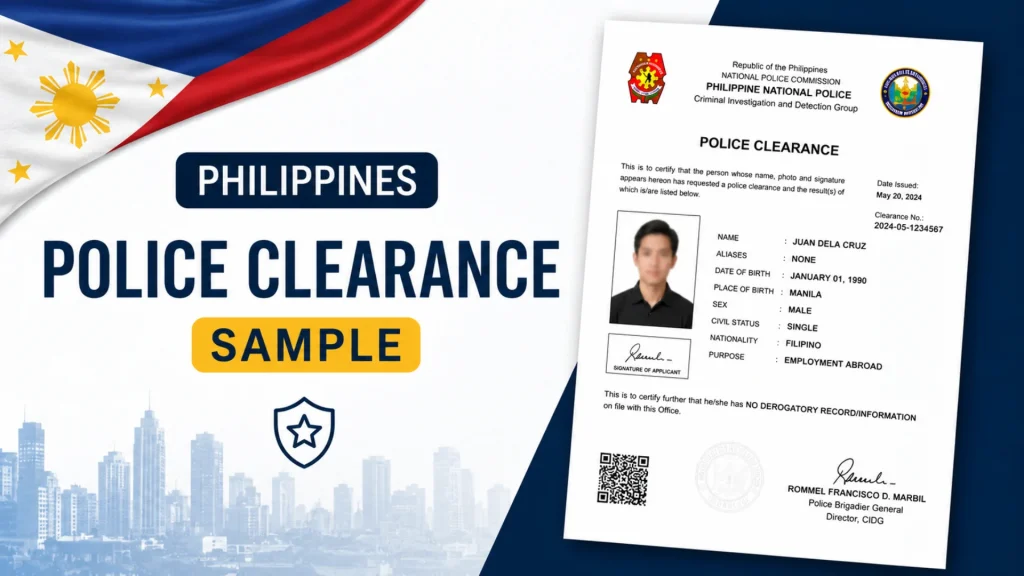
Philippines Police Clearance Sample: What Does It Look Like?
Understanding a police clearance sample helps you know what to expect when you receive your certificate and ensures there are no errors in your personal information. While the exact layout may vary slightly from station to station, all certificates follow the standard format set by the Philippine National Police.
Here is a detailed breakdown of every section found on a typical Philippine Police Clearance Certificate:
1. Header / Issuing Authority
At the very top of the certificate, you will find:
- Republic of the Philippines: Official designation of the issuing country.
- Philippine National Police: Name of the issuing law enforcement agency.
- Station Name: The specific PNP station or regional office that issued the clearance.
- Address: Full address of the issuing police station.
2. Document Title
Prominently displayed in the center or upper section of the document: NATIONAL POLICE CLEARANCE This clearly identifies what type of document it is.
3. Clearance ID Number
A unique clearance ID number or reference number is assigned to every certificate. This number is used for tracking purposes and for digital verification. Keep this number safe; it is your proof of authenticity.
4. QR Code
As of 2026, all Philippine police clearances include a QR code for digital verification. Employers, government agencies, or immigration officers can scan this code using any QR reader to instantly verify the authenticity of the certificate through the NPCS portal. This feature was introduced to prevent fraud and document falsification.
5. Personal Information of the Applicant
This section contains the complete identity details of the applicant:
- Full Name: Last name, first name, middle name, and suffix (Jr., Sr., III, etc.).
- Date of Birth: In MM/DD/YYYY format.
- Place of Birth: City/municipality and province.
- Sex: Male or Female
- Civil Status: Single, Married, Widowed, etc.
- Nationality: Filipino (or foreign national’s citizenship).
- Address: Complete residential address as declared during application.
Note: Always double-check that your name matches exactly your valid IDs. Even a small spelling difference can trigger a “hit” status and delay your application.
6. Applicant’s Photo
A recent ID photograph of the applicant is printed directly on the certificate. This photo is captured at the police station during your appointment; you do not need to bring separate photos for national police clearance applications.
7. Thumbprint / Fingerprint Impression
Your right thumbprint (and sometimes additional fingerprints) appears on the clearance certificate. This biometric data is captured during your visit to the police station and serves as a unique identifier to prevent identity fraud.
8. Applicant’s Signature
The applicant’s own handwritten signature is printed on the certificate for identity verification purposes.
9. The Clearance Statement
This is the heart of the document, the official certification text. A typical clearance statement reads, “If the background check returns a result, the word ‘DEROGATORY RECORD’ is replaced with the specific finding, and a follow-up investigation is initiated.”
10. Purpose of the Clearance
Some certificates include a field indicating why the clearance was issued, for example:
- For employment purposes.
- For visa or immigration application.
- For local government transactions.
- For banking requirements.
This field may be optional depending on the issuing station, but applicants are usually asked to state the purpose during the online application process.
11. Date of Issue and Date of Expiry
- Date Issued: The exact date when the clearance was printed and issued.
- Valid Until: Six months from the date of issue.
Note: A Philippine police clearance is only valid for six (6) months. After expiry, it becomes permanently invalid, and you must apply for a new one.
12. Issuing Officer’s Information
- Signature and Name of the Duty Officer: The PNP officer who processed your clearance.
- Designation: Often listed as PEMS (Police Examination and Monitoring Section) or similar.
- Signature and Name of the Officer-in-Charge: Approving authority at the station.
- Official Station Seal / Dry Seal: The official embossed or printed seal of the issuing police station.
Philippine Police Clearance Sample PDF 2026
How to Verify a Philippine Police Clearance Sample: Real or Fake?
The PNP now maintains a centralized National Police Clearance database, making verification more reliable than older local clearance systems.
1. Scan the QR Code
Every modern Philippine National Police (PNP) clearance contains a QR code. Scan it using your phone and verify that it directs to the official PNP verification system. The details shown online should exactly match the printed certificate.
2. Verify the Clearance Number
Check the unique police clearance number or reference number printed on the document. Enter it into the official verification portal: https://pnpclearance.ph/ If the system cannot find the record, the document may be fake.
3. Match Personal Information
Compare the following details with the applicant’s valid ID:
- Full Name
- Date of Birth
- Address
- Photograph
- Any mismatch is a warning sign.
4. Check Security Features
A genuine police clearance should include the following:
- QR Code
- Unique Reference Number
- Applicant Photo
- Official Seal
- Issuing Police Station Details
- Date of Issuance
- Missing security elements can indicate forgery.
5. Examine Print Quality
Fake documents often have:
- Blurry text
- Pixelated photos
- Poor-quality seals
- Different font styles
- Uneven spacing
- Official PNP clearances are professionally printed and standardized.
6. Contact the Issuing Police Station
If you are still unsure, contact the police station that issued the clearance and provide the clearance number for confirmation.
7. Compare with an Original Sample
Place the document next to a verified genuine police clearance and compare:
- Layout
- Fonts
- QR Code Position
- Seal Placement
- Overall Design
Common Signs of a Fake Philippine Police Clearance
- QR code does not work.
- The control number is invalid.
- Record not found in verification system.
- Blurry photo.
- Low-quality printing.
- Misspelled words.
- Incorrect website links.
- Missing security features.
- Altered dates.
- Inconsistent formatting.
Note: If multiple warning signs appear, the document should not be accepted without further investigation.
FAQs About Police Clearance Sample
Conclusion
A Philippine police clearance sample helps applicants, employers, and agencies understand the document’s format, security features, and verification process. By reviewing its key sections and learning how to verify authenticity through QR codes and clearance numbers, you can avoid fraud, ensure compliance, and confidently identify genuine police clearance certificates.