MTC Clearance Online in the Philippines 2026: Complete Guide
If you have ever sat across a government desk, paperwork in hand, feeling confident only to be told you are missing one more document you already know the particular frustration that comes with Philippine bureaucracy. That document, more often than not, turns out to be the MTC Clearance.
This 2026 roadmap exists so you do not waste a single trip. Whether you are applying for a firearms license, a government job, or a visa, this guide covers everything you need to know requirements, fees, steps, and the honest truth about what you can and cannot do online.
What is MTC Clearance?
The (MTC) Municipal Trial Court is a branch of the Philippine judiciary that handles what the legal system formally classifies as light offenses and civil cases. When that court issues you a clearance, it is officially called the Municipal Trial Court Certificate of Clearance, and what it communicates is straightforward: you carry no pending criminal case, no warrants, and no outstanding offense record within that court’s jurisdiction.
What makes this document distinct from a Police Clearance or an NBI Clearance is the layer of the legal system it touches:
- The NBI Clearance checks your criminal background at the national level.
- The Police Clearance reflects arrests on record with the Philippine National Police.
- The MTC Clearance goes directly into the judiciary into the Docket Books of the court to confirm you have never been formally charged, even for something as minor as a bouncing check or an ordinance violation.
Depending on where you live in the Philippines, the court issuing your clearance may carry a slightly different name:
| Court Name | Coverage |
|---|---|
| MTC – Municipal Trial Court | Municipalities |
| MTCC – Municipal Trial Court in Cities | Cities |
| MeTC – Metropolitan Trial Court | Metro Manila |
| MCTC – Municipal Circuit Trial Court | Multi-town areas |
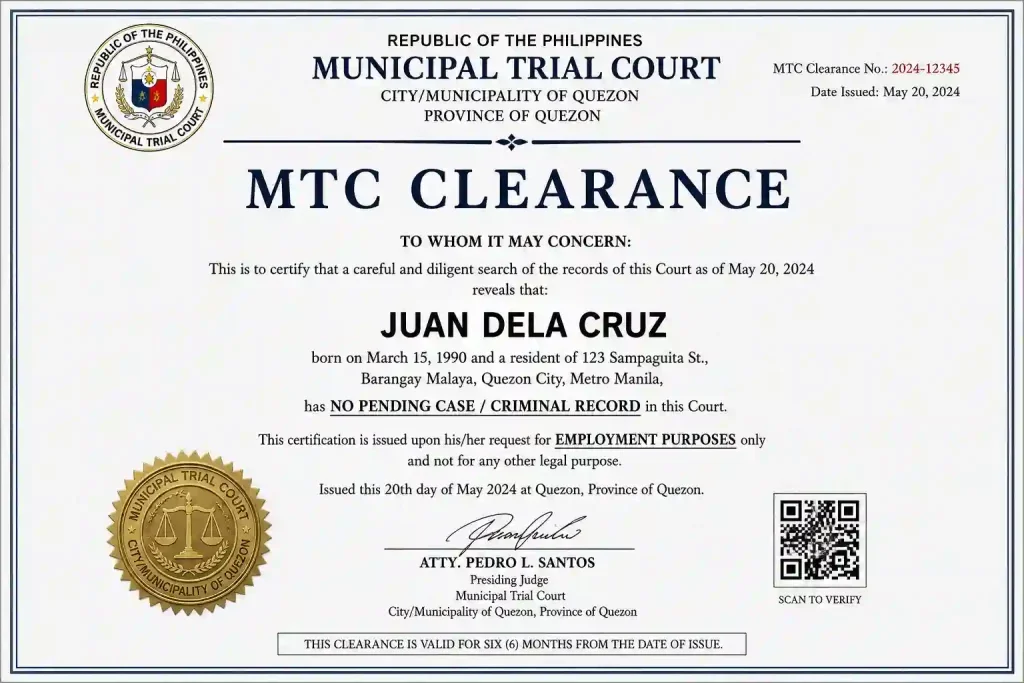
The official MTC clearance certificate looks the same regardless court seal, dry seal, signature of the Clerk of Court, and a certification statement confirming no pending case exists against you. This is not a document you get out of curiosity. It is a legal document with a defined purpose, and the moment an employer, embassy, or government agency puts it on their checklist, it becomes non-negotiable.
MTC Clearance Requirements
Walking into the Office of the Clerk of Court without a complete set of documents is one of the most avoidable mistakes in this process. Here is exactly what to prepare:
| Requirement | Purpose |
|---|---|
| Valid government-issued ID | Identity verification |
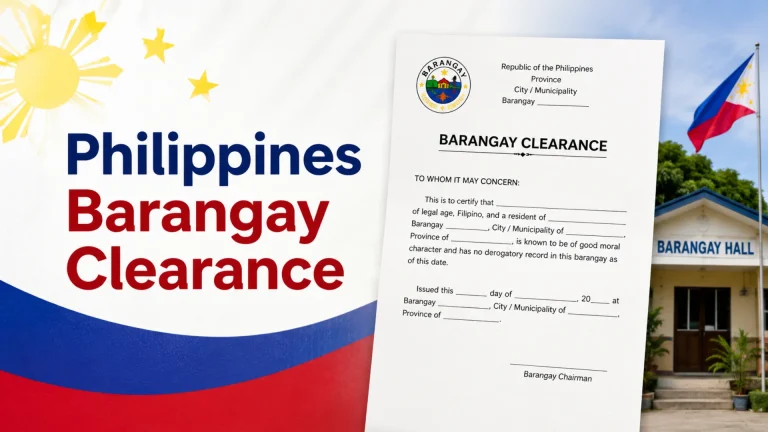
| Barangay Clearance | Proof of residency |
| Cedula / Community Tax Certificate (CTC) | Taxpayer verification |
| Filled application form | Official request |
| 2×2 ID photo | Clearance records |
| Payment receipt (Official Receipt / OR) | Proof of fee payment |
| Documentary stamp | Required by some courts |
| Utility bill or certificate | Alternative proof of residence |
Accepted Valid IDs
The court generally accepts any of the following:
- Philippine Passport
- PhilID
- UMID
- Driver’s License
- Postal ID
- PRC ID
- Voter’s ID
- Senior Citizen ID
Bring both originals and photocopies. The name must match exactly across all submitted documents — incorrect spelling is one of the most common reasons for delay.
For Foreign Nationals
Foreigners residing legally in the Philippines can apply, but additional documents are required:
- Passport
- ACR I-Card
- Visa documents
- Proof of legal residency
Requirements differ by court branch, so confirming ahead of time is essential.
Who is Eligible for MTC Clearance?
Eligibility is broader than most people assume. Any Filipino citizen or legal foreign resident can apply — citizenship is not a gatekeeping requirement. What matters is jurisdiction. You apply at the Municipal Trial Court that covers the area where you currently reside, as reflected on your Cedula or valid ID.
The Residency Nuance
If you lived in Makati for several years before moving to Taguig, and you are now applying for a firearms license or government position, you may be asked to secure an MTC clearance from both cities. The Taguig court has no visibility into Makati’s Docket Books — court records in the Philippines are not yet centralized nationally. Declaring your current residence clearly and consistently across your documents helps avoid being sent back for clearances from every city you have ever lived in.
The clearance is commonly required for:
- Government jobs and positions requiring high trust and responsibility
- Banking, security agencies, and legal and financial sector roles
- Overseas employment
- Scholarship applications
- Business permits
Non-residents can also apply at a court in a different municipality if they previously lived there and need to prove they carried no pending cases during that period. Specific requirements may vary slightly depending on location, so always confirm with your local court branch.
MTC Clearance Appointment Process
If your local Municipal Trial Court branch supports an appointment system, here is how it works:
- Visit the official website of your MTC or the Supreme Court of the Philippines portal.
- Navigate to the clearances or appointment section.
- Create an account using your personal information and contact details.
- Log in and proceed to the scheduling section.
- Choose a date and time for your appointment.
- Receive confirmation usually via email.
- On the appointment date, go to the MTC office with all required documents.
Not all branches have moved to this system. Many still operate on a walk-in basis. Whether you book in advance or walk in, visiting in the morning is consistently faster queues are shorter and processing moves more quickly before midday.
Step-by-Step Guide to Getting MTC Clearance
Step 1: Find the Correct Court
Locate the Hall of Justice in your municipality usually adjacent to the Municipal Hall or City Hall. Confirm which court branch covers your residential area (MTC, MTCC, MeTC, or MCTC) before making the trip. Applying at the wrong branch wastes the entire day.
Step 2: Get Your Cedula
If you do not have a current Community Tax Certificate, stop at the Treasurer’s Office first. You need the Cedula number to fill out the application form, and the court will not proceed without it.
Step 3: Go to the Office of the Clerk of Court
Proceed to the OCC and request the MTC clearance form. Fill it out completely:
- Full name
- Address
- Birthdate
- Purpose of request
- Contact details
Use a black ballpen and double-check all spelling before submission.
Step 4: Pay the Fee
Go to the cashier or authorized payment section. Pay the MTC clearance fee (₱50–₱100) plus the documentary stamp (₱15–₱30). Keep the official receipt you will need it at the next window.
Step 5: Submit Your Documents
Return to the OCC and submit:
- Completed application form
- Valid IDs (original and photocopies)
- Barangay clearance
- Cedula
- 2×2 photos
- Official receipt
- Supporting documents
Court staff will verify your identity and begin the records check.
Step 6: Record Verification
The Clerk of Court will search the Docket Books for your name, checking for:
- Pending criminal cases
- Warrants
- Derogatory records
- Active court proceedings
Verification time depends on the branch and daily application volume.
Step 7: Claim Your MTC Clearance Certificate
If no name match is found, your certificate is released typically within 10 minutes to 1 hour for walk-in applications. The official MTC clearance certificate will carry:
- Court seal and dry seal
- Signature of the Clerk of Court
- Date issued
- Official certification statement
If a name match appears often a namesake issue you may need to secure a Certification of No Pending Case or submit an Affidavit of Denial before release.
MTC Clearance Fee
The MTC clearance fee is genuinely affordable. Here is a general breakdown:
| Type | Estimated Cost |
|---|---|
| MTC clearance fee | ₱50 – ₱100 |
| Documentary stamp | ₱15 – ₱30 |
| Additional certifications | Varies by branch |
Bringing ₱150 in cash covers most scenarios. The exact MTC clearance price depends on the court branch and local policies always confirm the current amount before visiting.
Accepted Payment Methods
Depending on the court branch, payment may be accepted through:
- Cash at the cashier or Treasurer’s Office
- GCash
- Maya
- LandBank
- Debit or credit card
- Judiciary ePayment systems
Whatever method you use, keep your official receipt it is required at the OCC window.
MTC Clearance Validity
The validity period of an MTC Clearance in the Philippines is typically six months from the date of issue, though some courts issue clearances valid for as little as three months depending on the purpose. Always check:
- Expiration date printed on the certificate
- Court seal and authorized signature both must be present
Some employers, embassies, and government agencies require recently issued clearances, meaning even a five-month-old certificate may not be accepted if their policy demands something issued within the past 60 to 90 days.
Once expired, renewal means going through the full application process again with updated documents. The renewal timeline depends on:
- Employer policy
- Embassy requirements
- Government agency rules
- Court issuance date
MTC Clearance Contact Detail
For direct inquiries with the judiciary:
| JPAS Hotline | +63 2 8552-9644 |
| [email protected] | |
| Working Hours | Monday to Friday, 08:00 – 16:30 |
MTC vs. RTC vs. Prosecutor Clearance
This is the part that causes the most confusion the terms sound similar, the offices are often in the same building, and requirement lists frequently say “court clearance” without specifying which one.
| Clearance | Issued By | Covers | Common Use |
|---|---|---|---|
| MTC Clearance | Municipal Trial Court | Small crimes, civil cases (bouncing checks, ordinances) | Local jobs, gun license |
| RTC Clearance | Regional Trial Court | Serious crimes (murder, drugs, family cases) | Travel, migration, higher roles |
| Fiscal / Prosecutor Clearance | City Prosecutor | Cases under preliminary investigation | Gun license, filing cases |
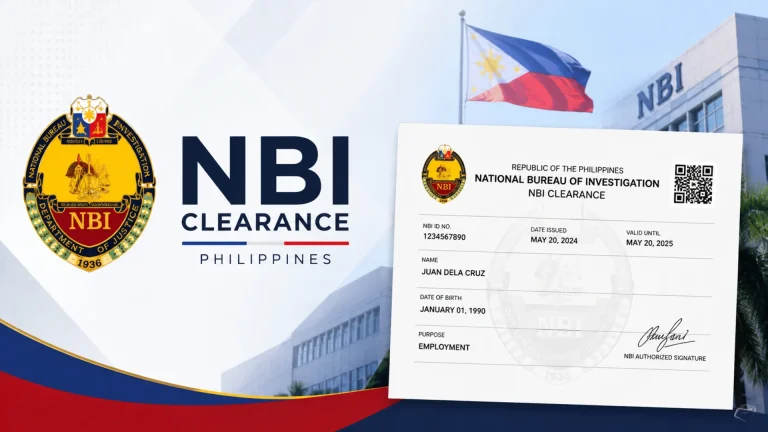
| NBI Clearance | National Bureau of Investigation | Nationwide criminal record | All-purpose |
| Police Clearance | Philippine National Police | Local police record check | Local employment |
| Barangay Clearance | Barangay Hall | Residency and conduct | Local transactions |
Important: If the requirement simply says “Court Clearance,” ask specifically whether they mean MTC, RTC, or both. For LTOPF firearms licensing, the PNP requires all three MTC, RTC, and Fiscal sourced from your place of residence.
MTC Clearance Sample
An MTC clearance sample follows a consistent format across court branches in the Philippines, printed on judicial stationery. Here is what it contains:
| Element | Details |
|---|---|
| Header | Republic of the Philippines, Municipal Trial Court of [Town/City] |
| Body | Certification that applicant has NO PENDING CASE on record |
| Applicant details | Full name, address, court branch |
| Authentication | Dry seal of the court |
| Signature | Clerk of Court |
| Date | Date issued |
| Photo | 2×2 photo (physical or digital capture) |
Any clearance missing the court seal or authorized signature should be questioned immediately these are what make the document officially valid.
MTC Clearance in Manila, Taguig, Cebu, and Cavite
Requirements carry the same core structure across the Philippines but differ in details depending on the city or municipality.
| Location | Notes |
|---|---|
| Manila | Processed through the MeTC (Metropolitan Trial Court). High volume morning visits strongly recommended. |
| Taguig | Requires valid ID, barangay clearance, Cedula, proof of address, and payment receipt. Partial digital services available in some branches. |
| Cebu | Some courts require additional verification or documentary stamps. Confirm requirements before visiting. |
| Cavite | Similar to Cebu additional documentary stamps may apply depending on the branch. |
Across all locations: bring originals and photocopies, arrive in the morning, and verify the current fee and schedule with your local Hall of Justice before visiting.
MTC Clearance for Employment
Companies across multiple industries now include MTC clearance for employment as a standard part of background verification. It fills a specific gap it confirms not just whether someone was arrested, but whether they were formally charged and whether a case exists in the court’s records. It is especially common for:
- Government jobs
- Banking institutions
- Security agencies
- Overseas employment
- Legal and financial sector roles
- Positions requiring a high degree of trust and responsibility
Some employers request both MTC and RTC clearance for higher-security positions. Others are satisfied with MTC alone for local employment. Either way, having a clean legal background confirmed across multiple levels MTC, RTC, NBI, Police Clearance builds a complete picture that institutions now expect.
The practical advice: get your MTC clearance early in the job application process. Validity runs between three and six months, and processing time, while usually fast, can extend if your name triggers a records check against a namesake in the Docket Books.
Do Small Claims Affect MTC?
Small claims cases are civil in nature and do not automatically generate criminal derogatory records. A civil dispute handled through the small claims process is not the same as a criminal case filed against you.
However:
- Unresolved court matters can still surface during verification depending on the jurisdiction and type of clearance requested.
- The Clerk of Court may flag pending civil court matters alongside criminal records during the check.
If you have any unresolved small claims or civil court proceedings in your history, consult the Clerk of Court before applying. Getting ahead of that conversation is significantly easier than explaining it after the fact.
Benefits of MTC Clearance
Most people treat this clearance as a box to check. That framing undersells what it actually does for you.
Compliance with Regulations
Philippine laws require clean court records across multiple levels not just police records. For anyone pursuing a firearms license under the LTOPF framework, the PNP Firearms and Explosives Office or FEO will not process your application without confirming you are not standing trial anywhere, including at the municipal level. The MTC Clearance, alongside the RTC and Fiscal Clearance, forms the compliance backbone of that entire process.
Facilitates Transactions
This clearance opens doors in ways people rarely anticipate:
- Bail bonds: Bonding companies use it to assess risk before committing.
- Travel and visa applications: Some embassies ask for court clearances to rule out a Hold Departure Order tied to something as civil as an unresolved bouncing check case.
- Employment and tenancy: Landlords and employers run it during the application process because it fills a gap that a standard police check cannot it shows whether you were charged, not merely whether you were arrested.
Enhanced Credibility
For government positions requiring moral fitness, presenting a clean MTC record alongside your RTC clearance signals something a police check alone cannot. In higher-security roles banking, security agencies, legal and financial sectors, overseas employment institutions treat this clearance as proof that trust in you is warranted.
Common Reasons for MTC Clearance Rejection
Most rejections and delays trace back to avoidable mistakes. Before submitting, review this list:
| Reason | What to Do |
|---|---|
| Incorrect personal information | Double-check name, address, birthdate on the form |
| Expired ID | Renew ID before applying |
| Blurry photocopies | Reprint clear, legible copies |
| Missing barangay clearance | Obtain before visiting the court |
| Pending criminal cases | Seek legal guidance to resolve |
| Unpaid court obligations | Settle before applying |
| Wrong jurisdiction | Confirm correct court branch for your address |
| Incomplete documents | Use the requirements checklist before going |
Frequently Asked Questions About MTC Clearance
Conclusion
Getting your MTC Clearance does not have to be an overwhelming experience once you know exactly what to expect. The process is straightforward secure your Cedula, visit the correct Hall of Justice, submit complete documents, and walk out with your certificate the same day. Whether you need it for employment, a firearms license, travel, or legal purposes, this clearance plays a non-negotiable role in proving your clean legal standing. Prepare right the first time, and the whole process takes less than an hour.