Barangay Clearance Online: How to Get a Barangay Clearance in the Philippines 2026
If you live in the Philippines, you already know that a barangay clearance is one of the first documents you’ll ever need whether you’re applying for your first job, registering a business, opening a bank account, or processing government IDs. Thousands of Filipinos still struggle with the process every single day. With the Philippines continuously embracing digital government services, many citizens now wonder whether they can obtain a Barangay Clearance online and what the exact process involves.
This comprehensive guide explains everything you need to know about the Barangay Clearance in the Philippines in 2026: what it is, why you need it, the exact requirements, how much it costs, and instructions for both in-person and online applications.
What Is a Barangay Clearance in the Philippines?
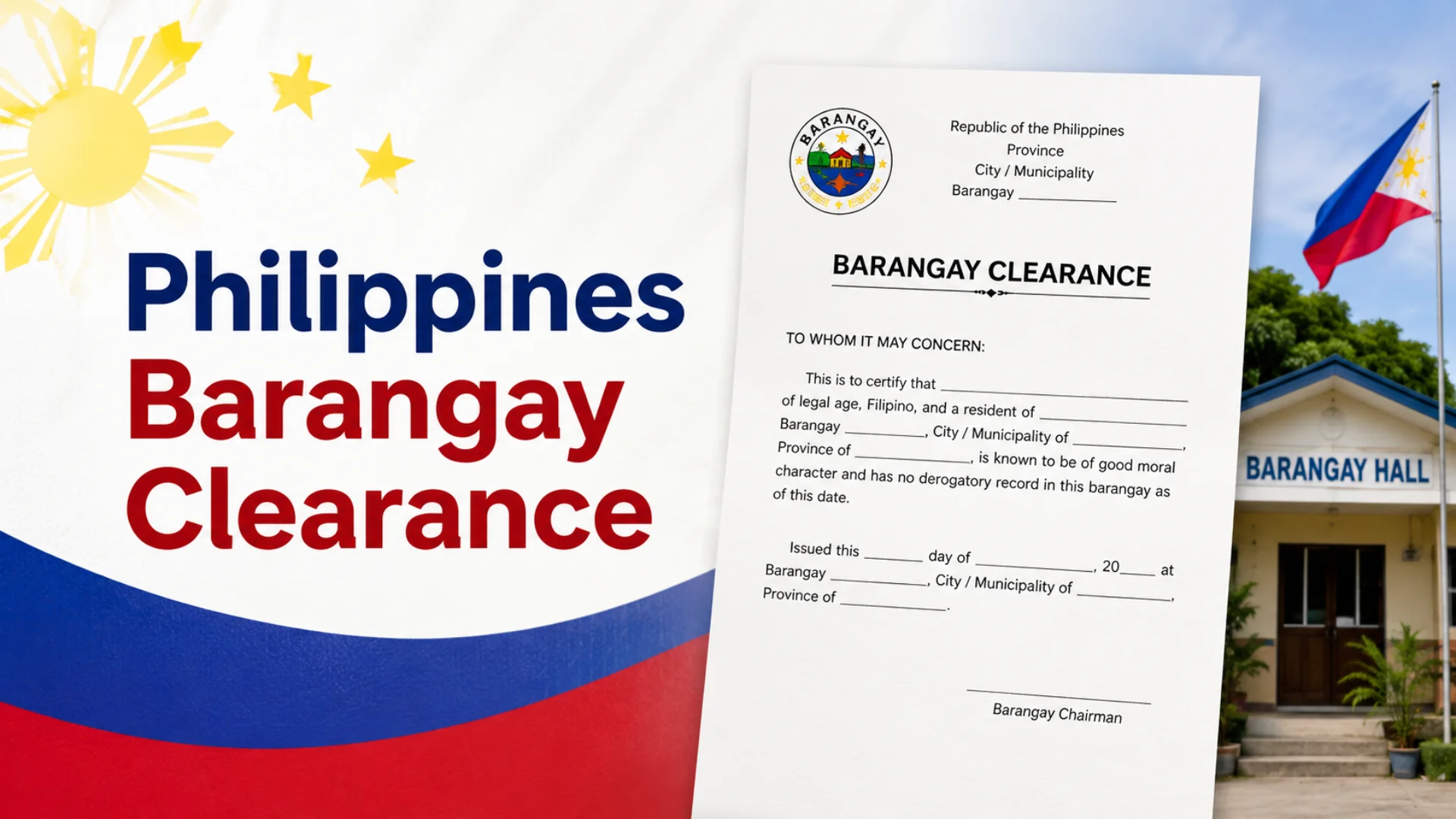
A Barangay Clearance (also called a Barangay Certificate of Good Standing or simply a Brgy. Clearance) is an official document issued by your local Barangay, the smallest unit of local government in the Philippines.
It serves two essential purposes:
- It confirms your residency, meaning you officially live within that barangay’s jurisdiction.
- It certifies your good moral character that you have no known pending cases, complaints, or criminal record within the community.
The document is signed by the Barangay Captain (also called the Punong Barangay) and is stamped with the official barangay seal. It typically includes:
- Your full name and address
- Date of issuance
- Stated purpose of the clearance
- Signature of the Barangay Captain
- Barangay official seal
The Legal Basis
The authority of barangays to issue clearances is grounded in Republic Act No. 7160, also known as the Local Government Code of 1991. This law grants local government units, including barangays, the power to issue permits and clearances related to their jurisdiction. Additionally, Republic Act No. 11261 (the First-Time Jobseekers Assistance Act) mandates that first-time job seekers are exempted from paying fees on certain government documents, including the Barangay Clearance.
Why Do You Need a Barangay Clearance in the Philippines?
A barangay clearance is one of the most widely required documents in the Philippines. Here are the most common situations where you’ll need it:
1. Employment Applications
Most formal employers, whether private companies, corporations, BPOs, or government agencies, require a barangay clearance as part of their pre-employment requirements. It is used to verify that you are a law-abiding resident with no local complaints or pending disputes.
2. Business Permits and Registrations
If you’re starting or renewing a business in the Philippines, your mayor’s permit application will almost always require a barangay business clearance as a prerequisite. You cannot get a business permit without it.
3. NBI and Police Clearance Applications
When applying for an NBI Clearance or PNP Police Clearance, you may be asked to present a Barangay Clearance as a supporting document, especially if you don’t yet have valid government-issued IDs.
4. Bank Account Opening
Many banks, especially for savings accounts and loan applications, require a Barangay Clearance as one of their Know-Your-Customer (KYC) documents. It serves as a supplemental proof of address and identity.
5. Government ID Applications
Getting a UMID card, Postal ID, or PhilSys National ID often requires a barangay clearance as proof of your current address and good standing.
6. Loans and Financial Transactions
Cooperatives, microfinance institutions, and some lending companies require a Barangay Clearance as part of loan processing, especially for community-based lending programs.
7. Scholarship and School Applications
Some schools and scholarship-granting bodies require it as proof of the applicant’s place of residence and good moral character.
8. Visa and International Applications
While not always required, some immigration applications and overseas employers may request a Barangay Clearance as part of a comprehensive background check package alongside NBI and police clearances.
9. Property Transactions
In some barangays, transferring or registering property or securing clearances related to real estate may involve a barangay clearance.
10. Legal and Court Requirements
Certain legal proceedings, especially those involving community disputes settled through the Katarungang Pambarangay (Barangay Justice System), may require a barangay clearance as part of documentation.
Barangay Clearance Requirements in the Philippines
The exact requirements may vary slightly depending on your specific barangay, but the following are the most commonly required documents across all barangays in the Philippines:
Standard Requirements for Employment Purposes
- Completed the Barangay Clearance Application Form available at the barangay hall or sometimes downloadable from the barangay’s official website or Facebook page.
- Valid Government-Issued ID (at least one of the following):
- Passport
- Driver’s License
- SSS/GSIS ID
- PhilSys National ID
- PRC ID
- Voter’s ID
- Senior Citizen ID (for senior applicants)
- Community Tax Certificate (Cedula): This is almost always required before the barangay will issue a clearance. You can purchase this at the barangay hall or city/municipal hall for ₱5 plus ₱1 per ₱1,000 of income. Getting your Cedula first is one of the most important steps people miss.
- Proof of Residency (if you’re a new resident or don’t yet appear in barangay records) — such as:
- Utility bill (electric, water, internet) in your name
- Lease/rental agreement
- Affidavit of Residency
Requirements for Business Purposes
- DTI Certificate (for sole proprietorships) or SEC Certificate (for corporations/partnerships)
- Lease contract or proof of business location
- Tax Identification Number (TIN)
Requirements for Foreign Nationals
- Valid Passport
- Valid Visa or ACR I-Card (Alien Certificate of Registration)
- Proof of current Philippine address
Requirements For First-Time Job Seekers
Under Republic Act No. 11261, first-time job seekers can apply for a Barangay Clearance without paying any fee. To qualify, you must:
- Be applying for employment for the first time
- Bring a Barangay Certificate confirming you are a first-time job seeker (some barangays issue this)
Barangay Clearance Requirements for Student
Students applying for a barangay clearance are usually required to prepare the following documents:
- Valid School ID (current and not expired)
- Proof of Residency in the barangay (if requested)
- Community Tax Certificate (Cedula), if required by the local barangay
- Duly accomplished application form
- Barangay clearance fee (amount varies by barangay)
How to Get a Barangay Clearance Online in the Philippines
The availability of online barangay clearance applications in the Philippines is growing but remains limited, and the experience varies widely depending on where you live.
As of 2026, many barangays in Metro Manila and major cities like Quezon City, Makati, Cebu City, and Davao have implemented some form of online or digital application system. Rural and smaller barangays, however, largely still require in-person applications.
How to Check If Your Barangay Offers Online Applications
- Visit your barangay’s official website; search for “[Barangay Name] + [City] + official website.”
- Check their official Facebook page. Most barangays, even those without full websites, maintain active Facebook pages where they post updates, announcements, and forms
- Call the barangay hall directly ask if they accept online applications or walk-in appointments
- Check your city government’s official website. Some LGUs (Local Government Units) maintain centralized online services for all barangays under their jurisdiction
Barangay Clearance Online Application Process (Where Available)
- Step 1: Visit the Barangay’s Online Portal https://e-barangayportal.online/ or e-Government System Access the online clearance system through your barangay’s website or your city’s centralized e-services portal.
- Step 2: Register or Log In Create an account if it’s your first time using the system. You’ll typically need to provide your full name, address, contact number, and email address.
- Step 3: Fill Out the Online Application Form Complete the digital application form with your personal information, the purpose of the clearance, and other required details.
- Step 4: Upload Required Documents Scan or take clear photos of your valid ID, Cedula, and any other required supporting documents and upload them to the portal.
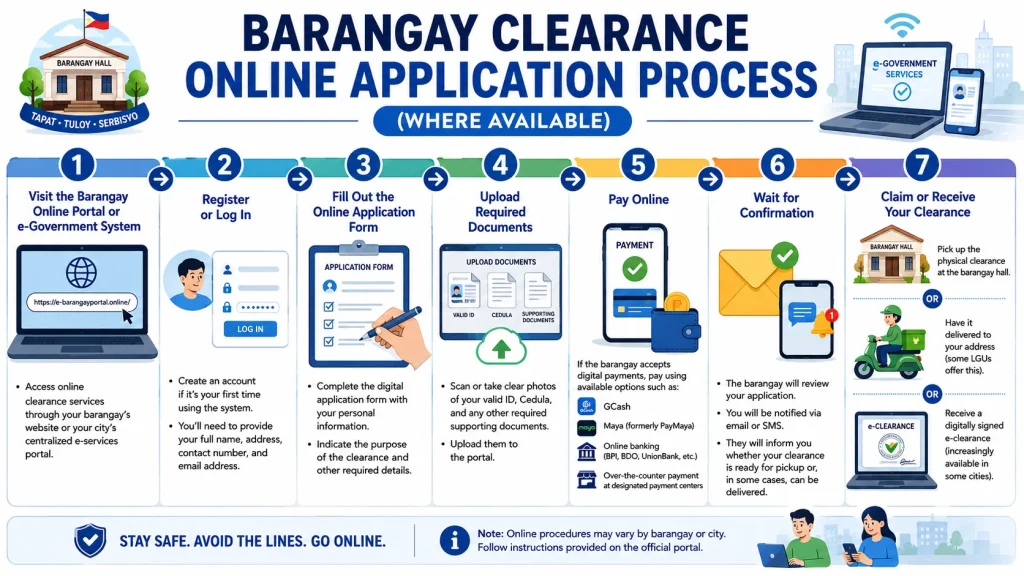
- Step 5: Pay Online If the barangay accepts digital payments, pay using available options such as the following:
- GCash
- Maya (formerly PayMaya)
- Online banking (BPI, BDO, UnionBank, etc.)
- Over-the-counter payment at designated payment centers
- Step 6: Wait for Confirmation The barangay will review your application and notify you via email or SMS. They will inform you whether your clearance is ready for pickup or, in some cases, can be delivered.
- Step 7: Claim or Receive Your Clearance Depending on the barangay’s system, you may need to do the following:
- Pick up the physical clearance at the barangay hall
- Have it delivered to your address (some LGUs offer this)
- Receive a digitally signed e-clearance (increasingly available in some cities)
Cities with Known Online Barangay Clearance Systems
- Quezon City has an established e-services portal
- Makati City some barangays accept online applications
- Cebu City digitalization efforts ongoing
- Pasig City integrated LGU digital services available
NOTE: If you’re outside these areas, it’s best to call your barangay hall first before assuming an online option is available.
How to Get a Barangay Clearance Process In-Person
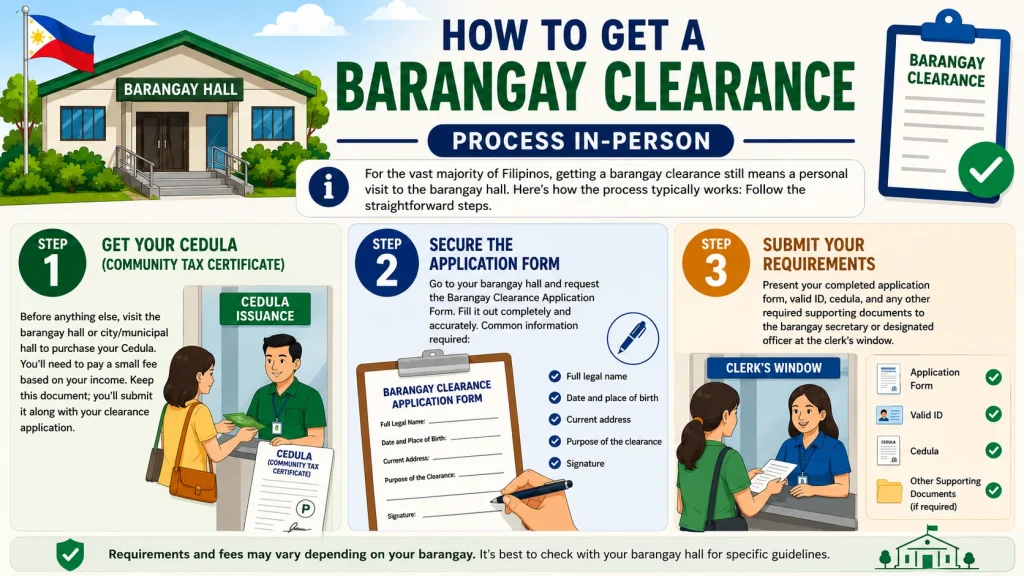
For the vast majority of Filipinos, getting a barangay clearance still means a personal visit to the barangay hall. Here’s how the process typically works: Follow the straightforward steps.
Step 1: Get Your Cedula (Community Tax Certificate)
Before anything else, visit the barangay hall or city/municipal hall to purchase your Cedula. You’ll need to pay a small fee based on your income. Keep this document; you’ll submit it along with your clearance application.
Step 2: Secure the Application Form
Go to your barangay hall and request the Barangay Clearance Application Form. Fill it out completely and accurately. Common information required:
- Full legal name
- Date and place of birth
- Current address
- Purpose of the clearance
- Signature
Step 3: Submit Your Requirements
Present your completed application form, valid ID, cedula, and any other required supporting documents to the barangay secretary or designated officer at the clerk’s window.
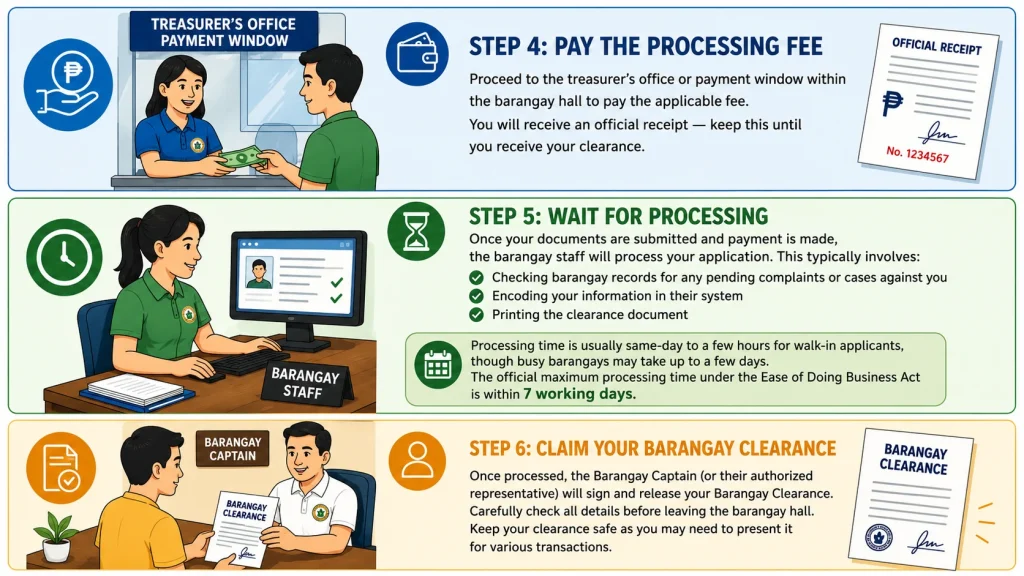
Step 4: Pay the Processing Fee
Proceed to the treasurer’s office or payment window within the barangay hall to pay the applicable fee. You will receive an official receipt — keep this until you receive your clearance.
Step 5: Wait for Processing
Once your documents are submitted and payment is made, the barangay staff will process your application. This typically involves:
- Checking barangay records for any pending complaints or cases against you
- Encoding your information in their system
- Printing the clearance document
Processing time is usually same-day to a few hours for walk-in applicants, though busy barangays may take up to a few days. The official maximum processing time under the Ease of Doing Business Act is within 7 working days.
Step 6: Claim Your Barangay Clearance
Once processed, the Barangay Captain (or their authorized representative) will sign your clearance and apply the official seal, and it will be released to you. Review the document carefully for any errors in your name, address, or other details before leaving.
How Much Does a Barangay Clearance Cost?
The fee is not standardized nationwide; each barangay sets its own rates under its local ordinance. However, here are the general ranges:
| Purpose | Typical Fee |
|---|---|
| Personal/Employment | ₱20 – ₱100 |
| Business Clearance | ₱100 – ₱500+ (depending on barangay and business type) |
| First-Time Job Seekers | FREE (under RA 11261) |
| Cedula (required before clearance) | ₱5 + ₱1 per ₱1,000 of annual income |
Some barangays, particularly in rural areas, issue clearances free of charge for personal use. In Metro Manila and urban barangays, the fee is usually between ₱50 and ₱200 for personal clearances. Business clearances typically cost more.
Barangay Clearance Validity
Yes. A barangay clearance is not valid indefinitely and has a limited validity period.
Standard Validity: In most barangays, a Barangay Clearance is valid for six (6) months to one (1) year from the date it is issued. However, the exact validity period may vary depending on your local barangay’s policies.
However, many institutions have their own requirements
- Employers often require a clearance issued within the last 3 to 6 months.
- Banks may require a clearance issued within 3 months.
- Government agencies may accept clearances valid for up to 1 year.
Note: Some barangay clearances do not explicitly print an expiration date. In these cases, the validity is determined from the date of issuance printed on the document. Always check with the requesting institution to confirm their specific validity requirement.
Barangay Clearance Sample, Format & PDF 2026
Barangay Clearance Online Registration
- Visit your barangay’s official website or LGU portal.
- Create an online account (if required).
- Fill out the Barangay Clearance application form.
- Upload the required documents.
- Pay the processing fee online, if available.
- Submit your application for verification.
- Download your clearance or collect it from the barangay hall once approved.
Note: Online registration is not available in all barangays. Check with your local barangay for the latest application process.
Barangay Clearance for Businesses in the Philippines
If you’re applying for a Barangay Business Clearance (separate from a personal clearance), the process is similar but requires additional documentation related to your business. This clearance is mandatory before you can secure a mayor’s permit or business license from your city or municipal government.
Requirements for Business Clearance
- Completed application form (for business)
- DTI Business Name Certificate (for single proprietors) or SEC Registration (for corporations/partnerships)
- Proof of business address (lease contract or ownership documents)
- Valid ID of the business owner or authorized representative
- Cedula of the applicant
Fees for Business Clearance
Business clearance fees are generally higher than personal clearances and may vary based on the nature and size of the business. Fees can range from ₱100 to ₱500 or more, depending on the barangay’s local ordinance.
Is Barangay Clearance Free in the Philippines
There is no nationwide fixed fee. Each barangay sets its own charges through local ordinances, so the cost varies depending on where you live and the purpose of the clearance.
When Is It Free?
Under the First-Time Jobseekers Assistance Act (RA 11261), qualified first-time job seekers can obtain certain government documents, including a Barangay Clearance, free of charge when applying for employment for the first time.
Getting a Barangay ID Using Your Barangay Clearance
Many residents apply for a Barangay Clearance as part of the process of obtaining a Barangay ID.
- What is a Barangay ID? A local identification card issued by your barangay to verify your identity and residency.
- Why get one? It is one of the easiest IDs to obtain, especially if you do not yet have other valid government-issued IDs.
How to apply:
- Apply for a Barangay Clearance.
- Ask the barangay office if they issue Barangay IDs.
- Pay the additional fee (typically ₱50–₱100, depending on the barangay).
- Your ID will be processed and usually laminated before it is issued.
History of Barangay Clearance in the Philippines
- Barangay Clearance originated from the old barrio system, where local leaders verified the identity and reputation of residents. Today, it serves as an official certification that a person is a resident in good standing and has no known local disputes or issues.
- It remains an important document for employment, business, and government transactions in the Philippines.
The Future of Barangay Clearance Online Services in the Philippines
The Philippine government continues to expand digital governance initiatives aimed at simplifying public services.
Future improvements include:
- Fully digital applications nationwide
- Integrated government databases
- Faster verification systems
- Mobile app applications
- Digital signatures and authentication
- Secure electronic document delivery
These developments will improve efficiency and reduce administrative burdens for citizens.
Tips for a Smooth and Fast Barangay Clearance Application
- Visit early Barangay halls are typically less crowded in the morning, especially on weekdays.
- Bring all documents in advance: photocopies of your ID, original Cedula, and any supporting documents.
- Check the barangay’s Facebook page Many barangays post updates about office hours, fees, and online systems.
- Call ahead A quick phone call to the barangay hall can save you a wasted trip. Ask about requirements, fees, and office hours.
- Keep your receipt Always keep the official receipt until you have the clearance in hand.
- Get extras Consider getting 2–3 copies if you’ll be needing the clearance for multiple purposes. The fee per additional copy is usually minimal.
Common Mistakes Barangay Clearance to Avoid When Applying
- Not getting a Cedula first Many applicants show up without a Cedula and are turned away. Get it before or on the same visit.
- Bringing the wrong ID Always bring a government-issued ID with your photo and signature. Informal IDs are often not accepted.
- Applying at the wrong barangay: You can only get a Barangay Clearance from the specific barangay where you officially reside. You cannot get it from a neighboring barangay.
- Not stating the purpose correctly Always specify the purpose (e.g., employment, bank account, NBI clearance). Some barangays issue different forms based on purpose.
- Applying too early If your employer requires a clearance issued within 3 months, apply close to your start date to avoid having to reapply.
- Forgetting proof of residency If you’re a new resident or your records aren’t updated in the barangay’s system, bring a utility bill or lease agreement.
Frequently Asked Questions
Conclusion
Obtaining a Barangay Clearance is a simple but essential step for many personal, business, and government transactions in the Philippines. Whether you apply online or visit your local barangay hall, preparing the required documents in advance will make the process faster and hassle-free. Always check your barangay’s latest requirements, fees, and procedures to ensure a smooth and successful application.